
Why women feel more tired than men: the science behind modern fatigue
Modern technology was supposed to make life easier. Robot vacuums clean our homes, groceries can be delivered in minutes, and smartphones allow us to manage dozens of tasks at once.
Yet many women say they feel more exhausted than ever.
Research suggests they are not imagining it. Studies consistently show that women report higher levels of stress, anxiety, sleep problems, and emotional exhaustion than men.
So why does fatigue remain such a common experience for women in the 21st century?
Women report stress and burnout more often
According to the American Psychological Association, women are significantly more likely than men to report that stress affects their mental health. Women are also more likely to describe themselves as overwhelmed by everyday responsibilities.
The World Health Organization estimates that anxiety disorders affect approximately 4.6% of women globally compared to 2.6% of men. Depression is also nearly twice as common among women.
While biological factors play a role, researchers increasingly point to social and lifestyle pressures as major contributors.
The invisible workload most people don’t see
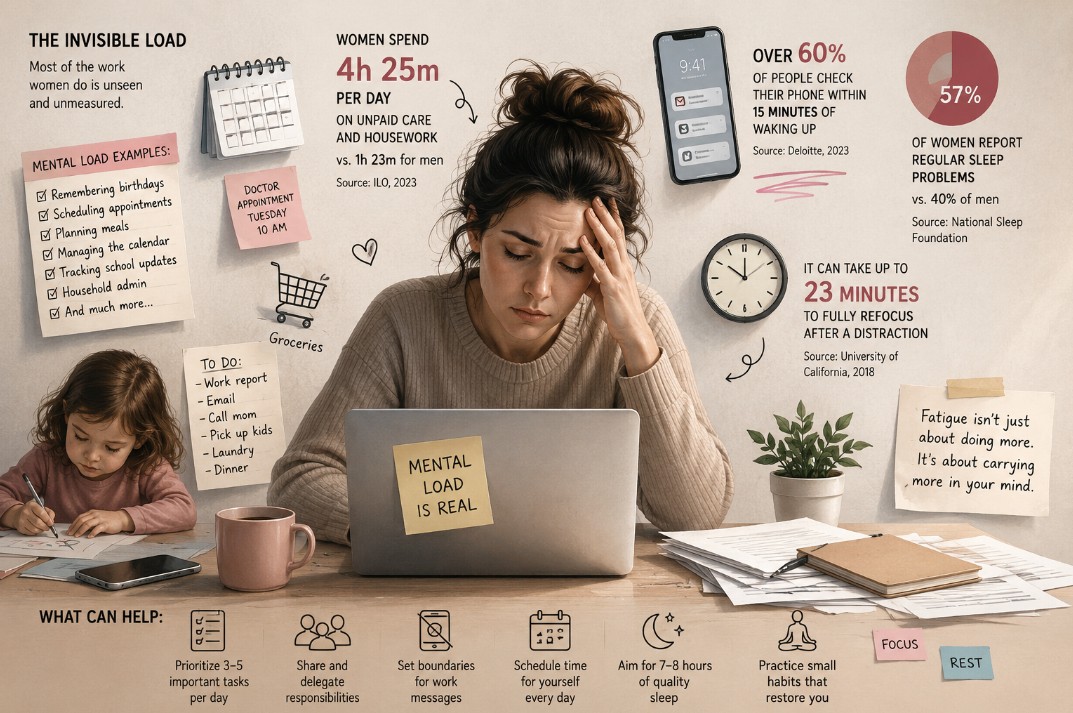
One of the biggest causes of modern fatigue is something psychologists call the mental load.
Mental load refers to the ongoing responsibility of organizing and managing everyday life.
It includes tasks such as:
- remembering birthdays and appointments;
- planning meals;
- scheduling medical visits;
- managing household budgets;
- tracking school activities;
- organizing family logistics;
- making hundreds of small decisions every week.
These responsibilities often go unnoticed because they are not physically visible.
A study published in the journal Sex Roles found that women continue to carry a disproportionate share of household planning and cognitive labor, even in relationships where chores are divided relatively equally.
In other words, someone may help wash the dishes, but another person still has to remember that dish soap needs to be purchased.
Women still perform most unpaid work
According to the International Labour Organization, women spend approximately 4 hours and 25 minutes per day on unpaid care and domestic work worldwide.
Men spend about 1 hour and 23 minutes.
That means women perform more than three times as much unpaid work every day.
Over a year, this difference amounts to hundreds of additional hours devoted to cooking, cleaning, caregiving, planning, and household management.
Researchers often refer to this phenomenon as the second shift.
After completing a paid workday, many women begin another shift at home.
Decision fatigue is real
Researchers estimate that the average adult makes tens of thousands of decisions every day.
Some estimates place the number at around 35,000 decisions daily.
While many of these choices are small, each one requires mental effort.
Studies in cognitive psychology show that decision-making gradually depletes mental resources throughout the day, leading to poorer concentration, lower self-control, and increased feelings of exhaustion.
Women who manage households often make decisions not only for themselves, but for partners, children, and family members as well.
The cumulative effect can be surprisingly draining.
Smartphones may be making things worse
Technology saves time, but it also demands attention.
According to Deloitte research, more than 60% of smartphone users check their phones within 15 minutes of waking up.
Many begin their day with emails, news alerts, work messages, and social media notifications before they even get out of bed.
Researchers at the University of California, Irvine found that after an interruption it takes an average of 23 minutes and 15 seconds to fully return to the original task.
A single notification may seem harmless.
Twenty or thirty interruptions throughout the day are a different story.
Each interruption forces the brain to switch focus, increasing cognitive fatigue and reducing productivity.
Sleep remains a major problem
Fatigue and sleep are closely connected.
According to the National Sleep Foundation, approximately 57% of women report experiencing sleep problems several nights per week, compared with about 40% of men.
Hormonal fluctuations, caregiving responsibilities, stress, and anxiety can all contribute to poorer sleep quality.
Even losing one hour of sleep per night can have measurable effects on mood, memory, concentration, and energy levels.
Research from the Centers for Disease Control and Prevention has linked chronic sleep deprivation to increased risks of heart disease, obesity, diabetes, and depression.
The pressure to excel everywhere
Today’s women face expectations that previous generations rarely encountered.
Many feel pressure to succeed simultaneously in several areas:
- career;
- family life;
- relationships;
- fitness;
- financial stability;
- personal development;
- social life.
A survey conducted by Gallup found that women are significantly more likely than men to report frequent feelings of stress during the day.
Psychologists note that exhaustion often develops not because people are failing, but because they are trying to meet too many expectations at once.
What actually helps?
Experts say reducing fatigue is less about finding a miracle solution and more about reducing the daily burden on the brain.
Research supports several practical strategies:
- prioritizing three to five important tasks per day;
- reducing unnecessary notifications;
- limiting work communication after hours;
- sharing household planning responsibilities;
- spending time outdoors;
- maintaining consistent sleep schedules;
- taking regular breaks from screens.
Even small changes can have a significant cumulative effect over time.
The bottom line
Modern fatigue is not simply a result of working hard.
For many women, it is the consequence of carrying invisible responsibilities, managing constant streams of information, and balancing multiple roles every day.
Technology may have reduced some physical demands, but it has not eliminated mental overload.
Understanding where that fatigue comes from is the first step toward protecting energy, improving wellbeing, and creating a healthier relationship with work, family, and everyday life.