
Why Gen Z and Millennials Are Less Likely to Build Romantic Relationships
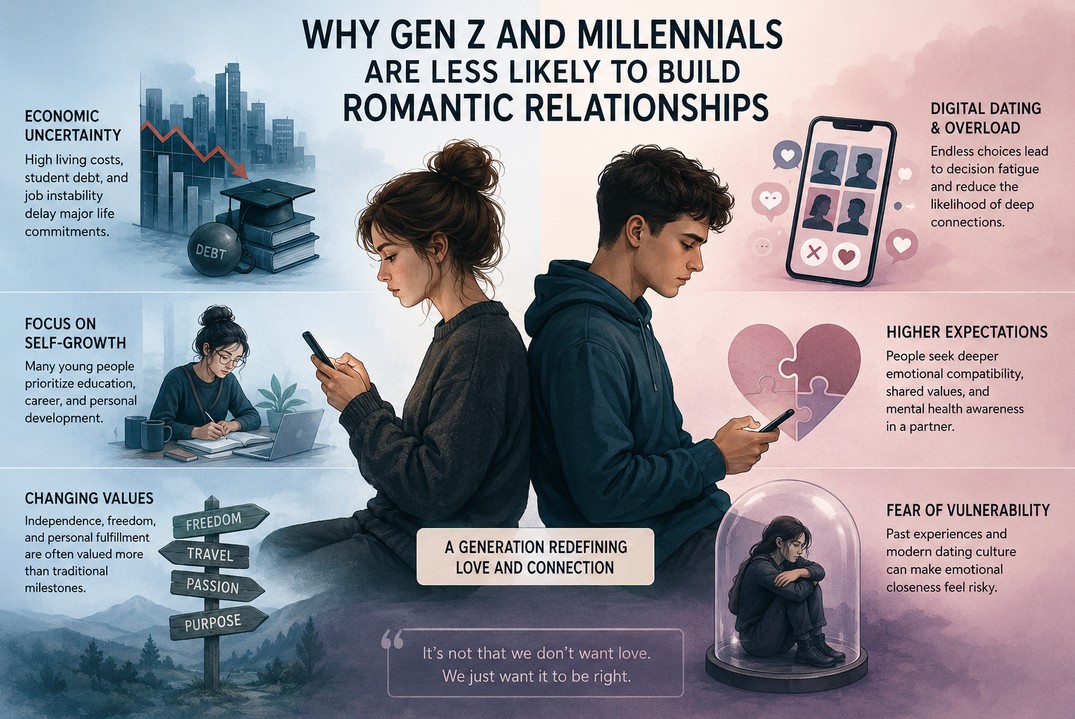
Over the past decade, countries across Europe, the United States, and parts of Asia have shown a consistent trend: young adults are entering romantic relationships later in life or avoiding long-term partnerships altogether. This is not a collection of isolated cases but a measurable behavioral shift among two generations — Millennials and Generation Z. Sociologists view this change as the result of overlapping economic pressures, digital environments, and evolving ideas about personal freedom and intimacy.
Delayed relationships as the new norm
Data from Pew Research Center and Eurostat show a steady rise in the age of first serious relationships and marriage. While 30–40 years ago stable partnerships often began in the early or mid-twenties, today many young people remain single well into their thirties.
Researchers link this to shifting life priorities. Education now takes longer, career entry is more competitive, and financial independence is achieved later. As a result, romantic relationships are no longer seen as an early-life milestone but as an optional choice rather than a social expectation.
Economic instability and the postponement effect
One of the key factors is economic uncertainty. Rising housing costs, labor market instability, and debt burdens (particularly student loans in the United States) contribute to what economists call a “postponement effect.”
Psychologists note that under high uncertainty, people tend to focus on individual stability — income, career development, and personal skills. Romantic relationships, in this context, are often perceived as an additional risk requiring emotional and financial resources.
Economists also point to a change in the “path to adulthood”: previously, financial independence and family formation progressed in parallel, whereas now these milestones are separated by years.
Digital environments and the paradox of choice
Dating apps have fundamentally reshaped how people search for partners. According to studies from Stanford University and MIT, digital platforms create a “paradox of choice”: the more potential partners are available, the harder it becomes to commit to one.
This leads to two opposing outcomes. On one hand, there is an increase in short-term interactions. On the other, the likelihood of forming long-term relationships decreases. Psychologists describe this as “choice inflation,” where the perceived value of each connection decreases due to constant awareness of alternatives.
Another contributing factor is emotional overload. Continuous comparison of profiles and relationship scenarios creates fatigue around the dating process.
Changing ideas about intimacy and autonomy
For Generation Z and part of the Millennial cohort, personal boundaries and psychological autonomy carry greater importance. Research by the American Psychological Association highlights a growing focus on emotional well-being, therapy, and self-reflection.
This reshapes romantic relationships: they are no longer viewed as a necessary social structure but as one form of interaction that must meet internal standards of safety and comfort.
At the same time, expectations for partnership have increased. People now seek emotional maturity, value alignment, and respect for personal space. As a result, the “entry threshold” for relationships is higher than in previous generations.
Psychological consequences of loneliness and its redefinition
Despite widespread narratives about rising loneliness, research paints a more nuanced picture. Loneliness has indeed increased as a social phenomenon, but its perception has also become more normalized as a temporary or conscious state.
Oxford and Harvard studies suggest that young people are less likely than before to view being single as a problem. However, prolonged social isolation can still increase risks of anxiety and lower subjective well-being.
Thus, the issue is not simply fewer relationships, but a broader redefinition of their role in life.
Frequently Asked Questions
Why are young people entering relationships later in life?
The main reasons include economic pressure, longer education periods, and shifting life priorities. People spend more time achieving financial and professional stability, which naturally delays the point at which relationships become a priority.
Do dating apps contribute to fewer long-term relationships?
Partially, yes. Research shows that digital platforms increase the number of interactions but reduce their depth. Constant access to alternatives creates substitution behavior and lowers motivation for long-term commitment.
Can avoiding relationships be considered the new norm?
It is better described as diversification of life paths rather than avoidance. For some people, relationships remain important, but they are no longer a mandatory stage of adulthood. This creates a more varied social landscape than in previous generations.
Conclusion
The decline in romantic relationships among Millennials and Generation Z is not driven by a single cause but by the intersection of economic conditions, technology, and cultural change. Rather than the disappearance of intimacy, it reflects a rebalancing of its role in modern life.